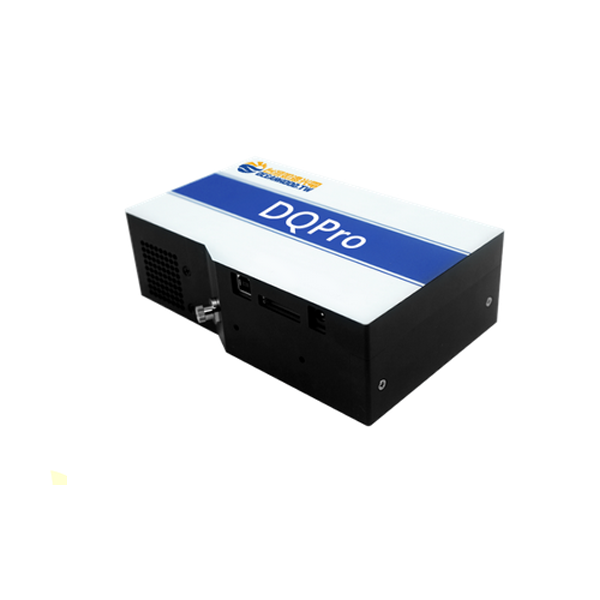
DQPro 16-bit TE-Cooled Fiber Optic Spectrometer_OC

Introduction

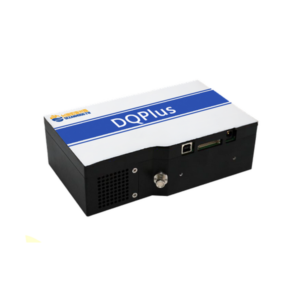
DQPro is a deeply TE-cooled fiber optic spectrometer with a cooling temperature down to -25 ℃. It features a compact structural design and a configurable spectral range. The spectrometer offers high resolution, reaching up to 0.1 nm, and low stray light of approximately ~0.5%. With excellent spectral response stability and reproducibility, it is well suited for a wide range of industrial on-site measurements, including laser measurement, plasma emission spectroscopy, color measurement, absorbance measurement, and Raman measurement.


Features

  • Cooling temperature down to -25 ℃, featuring extremely low readout dark noise and excellent stability.
  • Compatible with multi-core densely packed fiber bundles, with fiber insertion/extraction strength consistency ≤7%.
  • Wide dynamic range, high signal-to-noise ratio, and superior stability.
  • CCD quantization background noise ≤3 RMS (at minimum integration time). Equipped with multiple communication interfaces such as USB and serial port, along with a 24-pin interactive interface. Built-in dedicated DAC and ADC enable light source activation, intensity control, and power feedback.
分類:

Specification

Optical parameters
Optical fiber interface Key-SMA905
Number of pixels1 1024×58 pixels
Stray light ~5‰
Consistency of optical fiber insertion and removal ≤7%
Function parameters
AD sampling 16bit
Data interface USB2.0, RS232
Extended function interface 24PIN
Acquisition mode Single, continuous, software trigger, synchronous external trigger, asynchronous reset external trigger
Detector integration time 8ms-30min
CCD read noise2 ≤3
CCD dynamic range3 22000:1
CCD dynamic range (full signal)4 40000:1
Signal-to-noise ratio5 1000:1
Response linearity6 ≥98%
Others
Weight ≈1.24 kg
Dimension 181×111.5×55mm
Operating temperature 0℃~40℃
Working humidity 20%-85%
  1. Pixel configuration can be customized according to customer requirements as 2048×128 or 2048×256 pixels.
  2. CCD readout noise: measured as the root mean square (RMS) value at the minimum integration time.
  3. CCD dynamic range: under minimum integration time conditions, calculated as (saturation value – dark noise baseline) / standard deviation of CCD readout noise; evaluation method follows Oceanhood Taiwan’s standard.
  4. Dynamic range (full signal) is evaluated according to the CCD manufacturer’s specifications and industry-recognized standards.
  5. Signal-to-noise ratio (SNR) evaluation and calculation are performed in accordance with Oceanhood Taiwan’s standard rating method.
  6. Response nonlinearity is measured prior to calibration.